

| Author: | R.F. Kuang |
| Genre(s): | ➡️ Historical Fiction ➡️ Magical Realism |
| Series? | ❎ No |
| Goodreads Rating: | ⭐ 4.21 (192k ratings; 37.4k reviews) |
| Personal Rating: | ⭐ 5 / 5 Overall |
| Trigger Warning(s): | racism, mild violence |
🛑 Spoiler Warning 🛑
I might be recounting events, characters, and themes so THIS MIGHT BE FULL OF SPOILERS.
If you’d like to read a review with the spoilers hidden, kindly scroll to the bottom to read my spoiler-free summary in the ‘Recommendations’ section or head to my Goodreads post for a more detailed version with spoilers removed. You don’t need an account to read it. 🙂
BLURB
Traduttore, traditore: An act of translation is always an act of betrayal.
1828. Robin Swift, orphaned by cholera in Canton, is brought to London by the mysterious Professor Lovell. There, he trains for years in Latin, Ancient Greek, and Chinese, all in preparation for the day he’ll enroll in Oxford University’s prestigious Royal Institute of Translation—also known as Babel. The tower and its students are the world’s center for translation and, more importantly, magic. Silver-working—the art of manifesting the meaning lost in translation using enchanted silver bars—has made the British unparalleled in power, as the arcane craft serves the Empire’s quest for colonization.
For Robin, Oxford is a utopia dedicated to the pursuit of knowledge. But knowledge obeys power, and as a Chinese boy raised in Britain, Robin realizes serving Babel means betraying his motherland. As his studies progress, Robin finds himself caught between Babel and the shadowy Hermes Society, an organization dedicated to stopping imperial expansion. When Britain pursues an unjust war with China over silver and opium, Robin must decide . . .
Can powerful institutions be changed from within, or does revolution always require violence?
🌟Review (5/5) 🌟
Babel is one of those books that call on my intellectual and story-loving attention at every page and I love every moment of it.
‘Babel’ is like a well-built house. The plot gives it the most solid foundation; the walls are the world-building aspects enclosing the magical experience the reader is bound to have; the doors and windows are the characters that let us see through and navigate; all together roofed by the social and important topics of humanity like imperialism, colonialism, racism, activism, and so much more. Now take a step back and you get to see a solid structure worthy of admiration.
Plot. I very much enjoyed the slow pacing of this story. It was quite clever to do the world-building through Robin’s eyes because as a child plucked from his home country, he’s just as clueless as the reader. The world was introduced to me while actually developing an empathy with the main character. I enjoyed the first half for all its lessons on lexicons. It’s a lot of welcoming intellectual stimulations.
“Hussy was a compound of house and wife. Holiday was a compound of holy and day. Bedlam came, implausibly, from Bethlehem. Goodbye was, incredibly, a shortened version of God be with you.”
I enjoyed the last half for its emphasis on Robin’s moral dilemma between loving the knowledge and appreciating the comforts he gets from Oxford while its dark sides reveal itself to him as it overlaps with real social issues.
“Strikers in this country never won broad public support, for the public merely wanted all the conveniences of modern life without the guilt of knowing how those conveniences were produced.”
Characters. The characters certainly don’t feel like caricatures. Each of them was presented with very clear motives and multi-dimensional personalities. The students themselves are reminiscent of real people one would expect from a college. The intellectual discourses, shared stresses, formed friendships, and unintended rivalries all added to the complexity of the story. Even the professors displayed different charisma that matches their intellectual superiority and specialty in their lectures and interactions with the students.
“It would seem a great paradox, the fact that after everything they had told Letty, all the pain they had shared, she was the one who needed comfort.”
Recommendation
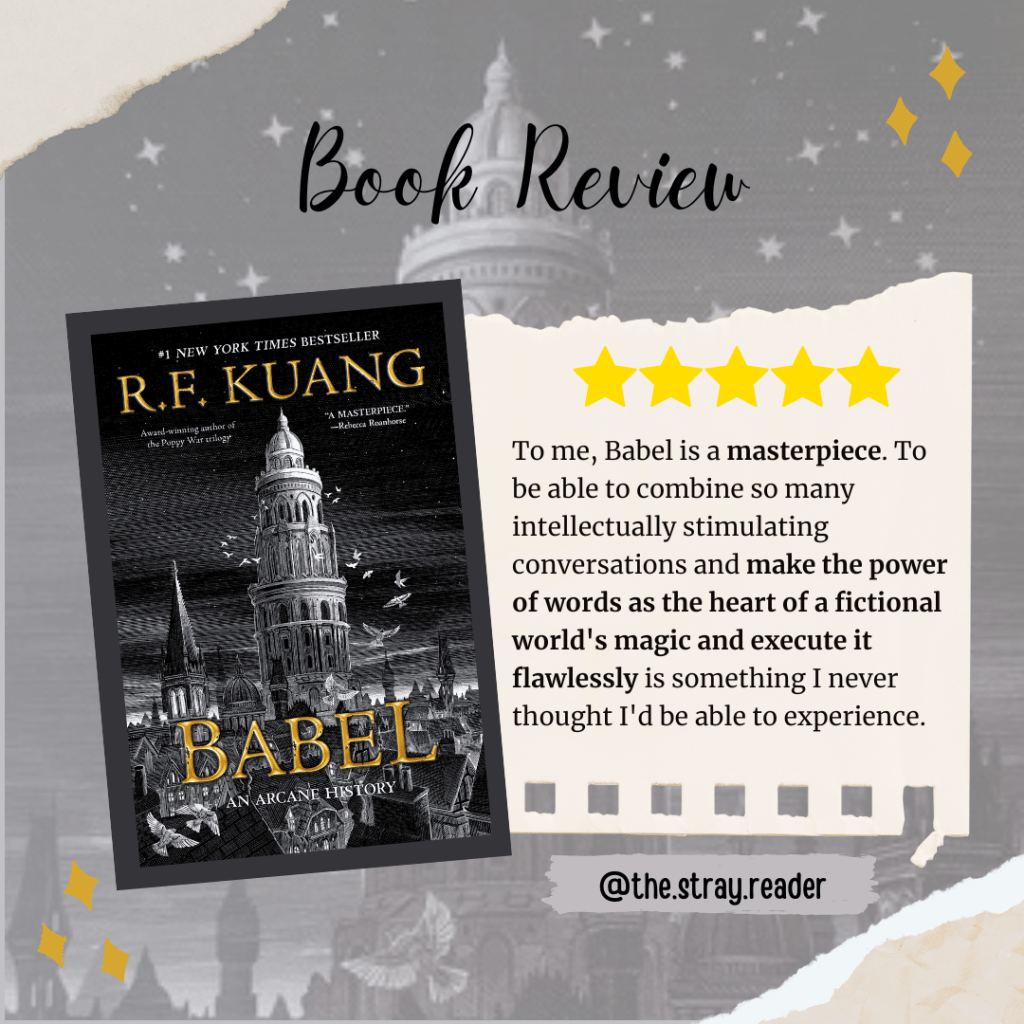
To me, Babel is a masterpiece. I’d like to think that I don’t say that very lightly. To be able to combine so many intellectually stimulating conversations and make the power of words as the heart of a fictional world’s magic and execute it flawlessly is something I never thought I’d be able to experience. The plot goes deep, the characters are engaging, the fights are exciting, and the lines made me stop in contemplation which reminded me of my experience when I read 1984 by Orwell. This is the type of fiction that rings close to a bookworm’s heart.
If all of that sounds enticing to you, check out R.F. Kuang’s ‘Babel’! I cannot recommend it enough!
FAVORITE QUOTE(S)
“Translation, from time immemorial, has been the facilitator of peace. Translation makes possible communication, which in turn makes possible the kind of diplomacy, trade, and cooperation between foreign people that brings wealth and prosperity to all.”
— Professor Jerome Playfair
“Words have no meaning unless there is someone present who can understand them.”
— Professor Jerome Playfair
“Languages aren’t just made of words. They’re modes of looking at the world. They’re the keys to civilization.”
— Anthony Ribben
“You fly no one’s flag. You’re free to seek your own harbour. And you can do so much more than tread water.”
— Griffin Lovell
“All sacrifice does is make you feel better. It doesn’t help the rest of us, so it’s an ultimately meaningless gesture.”
— Victoire Desgraves
“The university ripped us from our homes and made us believe that our futures could only consist of serving the Crown. The university tells us we are special, chosen, selected, when really we are severed from our motherlands and raised within spitting distance of a class we can never truly become a part of. The university turned us against our own and made us believe our only options were complicity or the streets. That was no favour, Sterling. It was cruelty. Don’t ask me to love my master.”
— Robin Swift
 The Stray Reader
Leave a comment